
When Monotony Creeps In: The Two Stages of an Optometry Career

I was at a lunch with a colleague, and he confided something many of us feel long before we ever say it out loud:
He was feeling the monotony.
As rewarding as the work is, his days were starting to blend together.
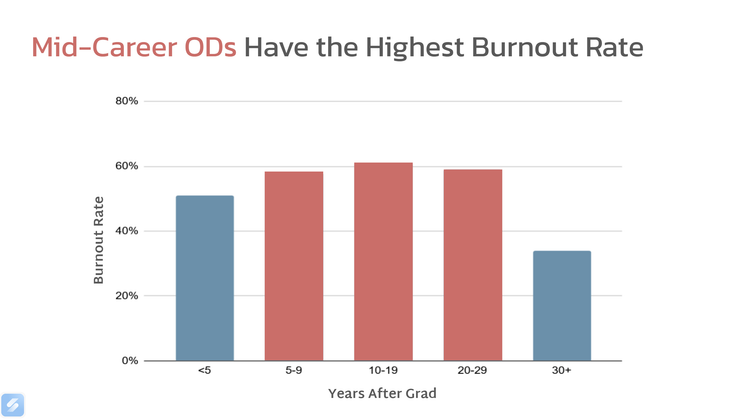
He even had a theory — that around five years after graduation, monotony begins to creep in for him and for many of his peers.
And honestly? My experience has been similar.
The First Stage: Fitting In
My first years out of school, I was working six or seven days a week because I was so passionate. After years of lectures, labs, and clinics, I could finally apply what I learned, help a lot of people, and get paid for something meaningful.
But that phase also came with a humbling realization: I knew far less than I thought.
I always tell optometry students that graduation isn’t the finish line — it’s the starting line. To become a competent, seasoned optometrist, you have to learn far more than just improving clinical skills:
- Referral networks
- The admin side
- How provincial health systems actually work
- and much more that you learn on the job.
And all of that growth feeds directly into work happiness. You feel yourself becoming better and better.
One colleague described it as a “rite of passage” for optometrists — the early years where you master your craft: refracting accurately, managing tough cases, and becoming an effective communicator.
This first phase of your professional journey is about fitting in. Learning what everyone else before you had to learn to become a competent primary care optometrist.
Year Five: When Things Get Quiet
Around year five, you’ve seen most of what you’re going to see as an optometrist.
Retinal detachments don’t rattle you. You know how to communicate effectively with patients. And even when something new pops up, you know how to navigate it.
Sure, you can always get better. But the improvements noticeably slow down. And that’s often when the monotony shows up.
Not because the work is any less important.
Not because you’ve stopped caring.
But because the phase of rapid challenge and growth has slowed down.
This is where many people stay — comfortable, polished, and professionally “good enough.”
But it’s also where some people start to feel misaligned: their career is fine on paper but it no longer lights them up.
The Second Stage: Fitting OUT
This next stage is no longer about fitting in.
It’s about fitting out — discovering what makes you different.
In our formative years, we spend so much time following other people’s values: parents, peers, society. It’s no surprise we wake up one day and realize we’ve been living someone else’s dream.
Your professional life can follow the same pattern.
You become extremely good at fitting in — at meeting expectations, at doing the “right” things, at being the dependable clinician. But you can’t discover your true purpose if you’re only chasing external validation.
The shift to fitting out begins when you find the courage to forge your own career path.
Maybe you aspire to be a speaker.
Or a consultant.
A clinical researcher.
A leader.
This is where self-discovery comes in.
You experiment.
You test your interests, your limits, your values.
You ask: What is a path that I want to take?
Double down on your passions and start your unique career path.
Two Stages of an Optometry Career
If you’re fresh out of school:
Go through the rite of passage.
Spend most of your energy honing your primary care skills.
This is your foundation — you can’t skip it.
Master your craft, build your confidence, and learn to fit in.
If you’re years into practice and can do an eye exam with your eyes closed:
This is your time to fit out. To differentiate yourself.
Move toward work that lights you up and forge your own path.
The Path Forward
Monotony isn’t a sign that something has gone wrong.
As good as the first chapter of your career was, it’s a sign that you're ready for the next chapter.
How will you fit out?





Member discussion